Picking the winner from the 20 horse field at the Kentucky Derby is hard. So hard, in fact, that no expert polled by SBNation was able to do it.
That’s why the holy grail at the racetrack is the Superfecta, where bettors are asked not only to pick the winner, but the second, third and fourth horses to finish the Derby. This is fiendishly difficult task that, not surprisingly, defeated every expert at Churchill Downs, where no one predicted the top four horses correctly, much less in the correct order. In the world of AI, even Bing Predicts blew it, picking only heavily favored Nyquist to win the race, but missing the other 3 picks entirely.
So, when Hope Reese, a reporter for TechRepublic and the Atlantic, challenged Unanimous A.I. to use UNU to predict the winners of the Kentucky Derby, “we were reluctant to take on this challenge,” says David Baltaxe, Chief Information Officer at Unanimous. “Nobody here knows anything about horse racing, and it’s notorious for being highly unpredictable. Still, UNU surprises us again and again, so we recruited a swarm of volunteers through an online ad. The whole thing took 20 minutes.”
During an initial 10-minute session, the group used UNU to answer questions as a unified Swarm Intelligence, narrowing the field of 20 horses down to four winners. The swarm was then asked to order the four winners into Win, Place, Show, and Fourth. Then, a week later the Kentucky Derby announced the post positions of the horses, which impacts the potential outcome. So, the Swarm Intelligence was convened again, and asked if any changes should be made. One of the four picks was replaced by an alternate. This process took another 10 minutes.
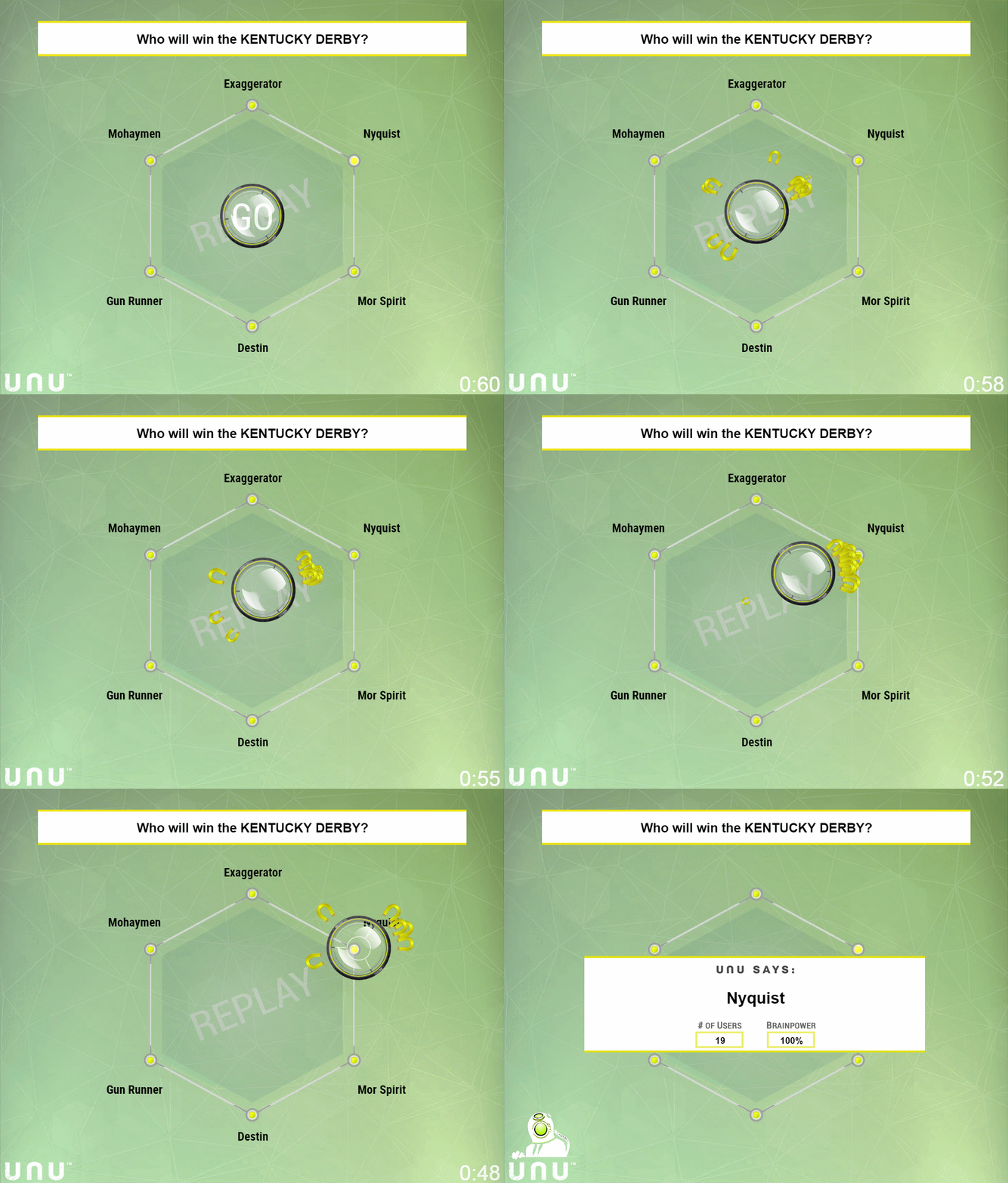
Below is a replay that shows the Swarm Intelligence making one of the many decisions required to predict the full outcome of the race:
So, what happened at the Derby? Hope Reese, the journalist who issued the Kentucky Derby challenge and published the predictions in Tech Republic last week, put down a single dollar on UNU’s picks for the Superfecta. After the dust had settled on the “most exciting two minutes in sports”, that single dollar had turned into a whopping $541. That’s quite a return on investment.
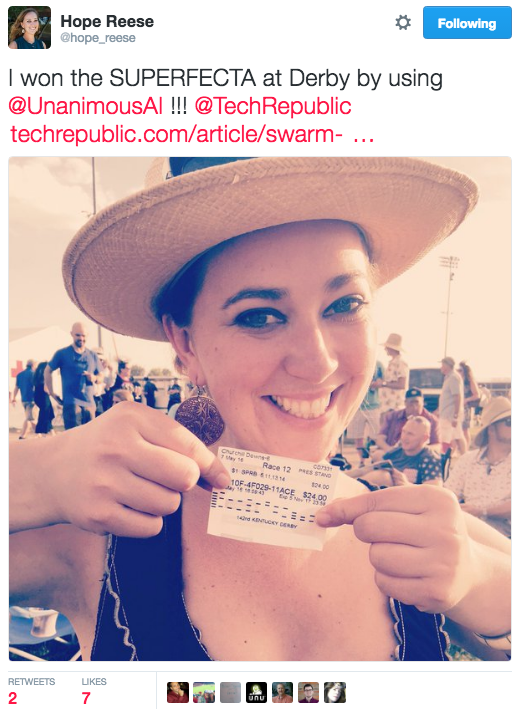
Of course, knowing that UNU made remarkably accurate predictions on the Super Bowl, the Oscars, the Stanley Cup, the NCAA bowl games and more, we were a little more confident in UNU’s picks. So, the team here at Unanimous put down $20 on the Superfecta….and turned it into nearly $11,000! Yes, we are kicking ourselves that we didn’t go bigger, but we mostly we just wanted a record of the bet for posterity. Here is the official ticket:

Full disclosure, when you’re generating 5400% ROI by tapping into a new form Swarm Intelligence, it’s easy to forget that we also bet $20 on the Trifecta and won an additional $2,000. That’s a win of $12,822 on bets costing $40. Mint juleps on UNU!
How does Swarm Intelligence work? It goes back to the birds and bees. Ants too. And fish. From swarms and flocks, to schools and colonies – countless species have evolved techniques to amplify their intelligence in closed-loop systems that pool their insights and converge on optimal decisions, proving the old adage – many minds are better than one. And now, with UNU, we humans can form real-time swarms and achieve similar amplification.
Researchers also compare the power of swarms to standard polls. Using survey data from the individuals who participated in the Kentucky Derby swarm, researchers asked – what if this group had taken a vote and bet on the horses that were the most popular picks? It turns out that if you take the most frequent picks made by the participants on their own, the group would have collectively gotten only one correct horse out of the 4 picks– the favorite, Nyquist. That’s hardly impressive.
Why do swarms outperform polls, surveys, and markets? Millions of years of evolution should give us a clue. The birds and the bees don’t vote, or take surveys, or use sequential prediction markets. They form real-time dynamic systems that explore a decision space together, in synchrony, and converge on optimal solutions in unison. Now humans can too…
If you want to be part of a future Swarm, try UNU now by click here: UNU.
Or join the UNU Beta program here: