The Super Bowl is among the most anticipated television events in the world, both for the sporting spectacle and for the advertisements. For brands investing millions of dollars in a Super Bowl ad (this year, 30 seconds cost $8M to $10M), it is their best opportunity to reach the single largest US viewing audience all year.
Immediately following the game, articles were everywhere that listed the “Top Super Bowl Ads”. It seems like everyone has an opinion about which ads were the “best” or “worst”. Most of these articles are written by a single person, and even when that person has expertise in the field, they are still providing their subjective assessment of how memorable, or effective, or activating, the ad is. And applying their own view of what elements of the ad were responsible.
At Unanimous AI, we figured there’s a better (and more logical) way of finding out which ads were the “best”: Instead of asking an individual person’s opinion, we invited over 100 Super Bowl viewers to take part in a discussion about which ads were the most effective, and importantly, why they were effective. Because if we want to learn what makes a memorable ad, we should find out what makes people remember those ads.
Surveys don’t provide the full picture for such a nuanced subject. Surveys just ask individuals for whatever stuck top of mind. It’s useful because you can get a lot of responses, but it doesn’t provide a depth of understanding of why the ad really works (or doesn’t).
Assembling a live group in deliberative conversation is better, but behavioral dynamics keep the effective group size to under ten. Above that, people aren’t interacting, they’re speaking to be heard, … if they’re sharing at all.
Thinkscape® is the ideal platform for this kind of research because it solves the problem of collecting deep qualitative insights at quantitative scales. It works using a patented AI technology called Hyperchat AI™ that connects groups together at unprecedented scale, enabling thoughtful deliberation instead of surface polling.
When large groups engage in productive debate, deep insights are revealed along with true measures of sentiment. Studies show that when working together in Thinkscape, large groups arrive at more accurate forecasts, deeper insights, and better decisions. (See the results of the Thinkscape Super Bowl game predictions session here.)
For this study, we brought together 107 people on the Thinkscape platform who watched the Super Bowl and the commercials and asked them to deliberate “What was the most effective 2026 Super Bowl ad, and why?”
The group discussed more than 60 ads – in and of itself a great indicator of which ads were memorable. For each, Thinkscape captured the discussion, the reasons people gave for supporting or rejecting the ad, and how strongly they felt about it. In addition, Thinkscape calculated metrics of engagement, share of conversation, and statistical effect sizes, as the participants interacted.
The Top Ten
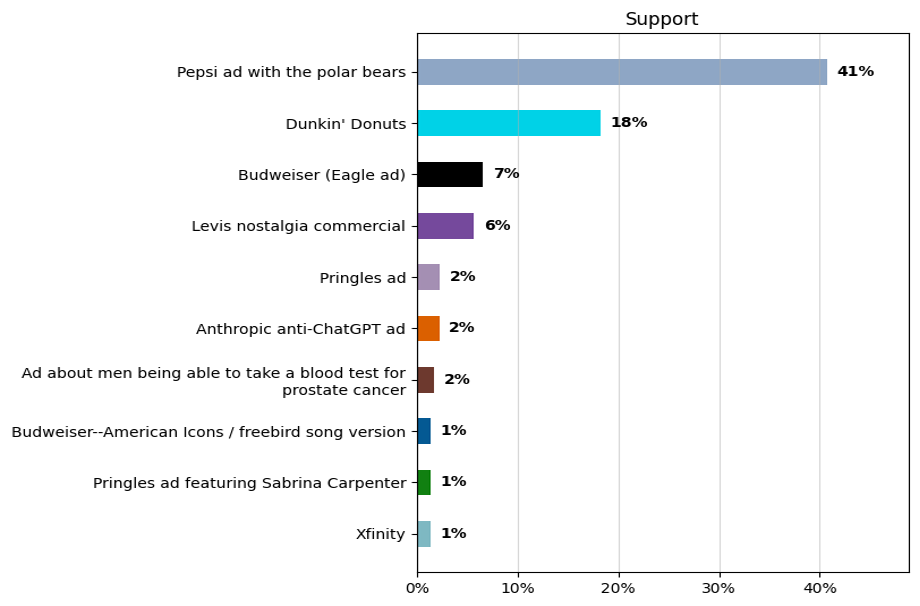
While over 60 ads were mentioned in the real-time discussion, Thinkscape automatically tracks the sentiments of every individual in real-time as well as the global sentiment across all 100 participants. As the debate unfolds, it continuously identifies the group’s top ten choices based on real-time analysis of the conversations. As soon as the conversation is complete it reports a wide range of statistics, including the top ten supported choices as shown here:
Thinkscape also automatically output insights about each of the advertisements discussed. Here are some examples:
1. Pepsi’s ad featuring one of Coca-Cola’s most recognizable pitch-characters, the Polar Bear, received the highest conversational Support by a wide margin (41% of total support). This was a statistically significant result for a population of general consumers (p<0.01). Participants indicated that it hit all the right notes:
- Highly memorable because of the surprise of seeing Coke’s polar bear switch sides;
- By taking jabs at Coke it was fun and nostalgic, as participants referenced Coke vs Pepsi ads during the “Cola Wars”;
- Family-friendly fun was greatly appreciated, even if one of the funniest elements was the Coldplay-like exposure of the couple.
Most of the negative feelings toward this ad were related to the discomfort viewers felt with Pepsi using an iconic Coke character. But maybe that makes it more memorable, too.
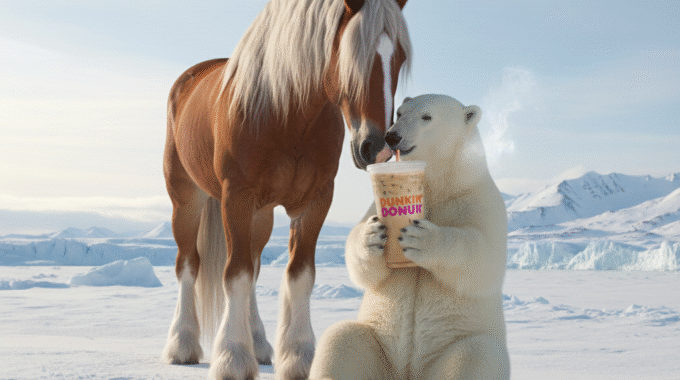
2. The Dunkin’ spot, which featured a crowd of ‘90s sitcom actors, received the next highest share of Support (18%). Participants indicated the ad was effective because:
- The sheer number of cameos (from Brady to Urkel) was both unexpected and appreciated, inspiring much discussion;
- The humor of the spot was appreciated and thought it landed well with its intended audience.
Some participants pushed back, indicating that the ad was overloaded with celebrities, did not tie to the product, and relied too heavily on CGI (to make everyone look like their younger selves).
3. This year, Budweiser returned to their iconic Clydesdales and spun a story rich with American symbolism, featuring a baby Bald Eagle. The ad had the third-highest average Support score (7%), as viewers felt it:
- Was very on-brand and patriotic;
- Featured very appealing animals and the very memorable “winged Clydesdale” shot;
- Was emotionally touching and paired well with the music of “Free Bird”.
Detractors found it confusing and overly-sentimental.
4. Levis’ commercial, which featured a parade of close ups of the backsides of wearers of their jeans, received 6% of participant’s Support. Participants thought that it was the most effective ad of the night because:
- It clearly focused on the product;
- All the butts made it memorable and kind of funny;
- People responded to the references to celebrities, characters, album covers, etc. that they loved.
The primary reason against this commercial was a sense that it was overly-sexualized and it wouldn’t appeal to all tastes.
For the record, we also asked this real-time collective to consider a follow-up question, Which Super Bowl ad was the least effective and why?This is what the system reported after 10 minutes of deliberation:
“Our collective perspective is that the worst 2026 Super Bowl ad was the Coinbase ad. We found it lacking in clarity, with confusing messaging and a failure to explain the product effectively. Additionally, the ad was found by many to be annoying, cringey, and low-effort, with little promotion of the product and a disconnect from Coinbase’s services. Overall, it failed to build trust and was off-putting to many viewers.”
This too was a statically significant result (p<0.01).
The same benefits of large group collaboration can be applied to large business teams that need to make important decisions, brainstorm solutions, or simply come to alignment – while allowing team leaders to understand the reasons behind the answers.
To learn more about the responses to other Super Bowl ads, or to find out how Thinkscape could help your team or brand, visit thinkscape.ai or drop us a line at contact@unanimous.ai.